How Many Moving Boxes Do I Need?
Estimate a useful starting range by home size, belongings, and the rooms you actually need to pack.
Start with a range, not a promise
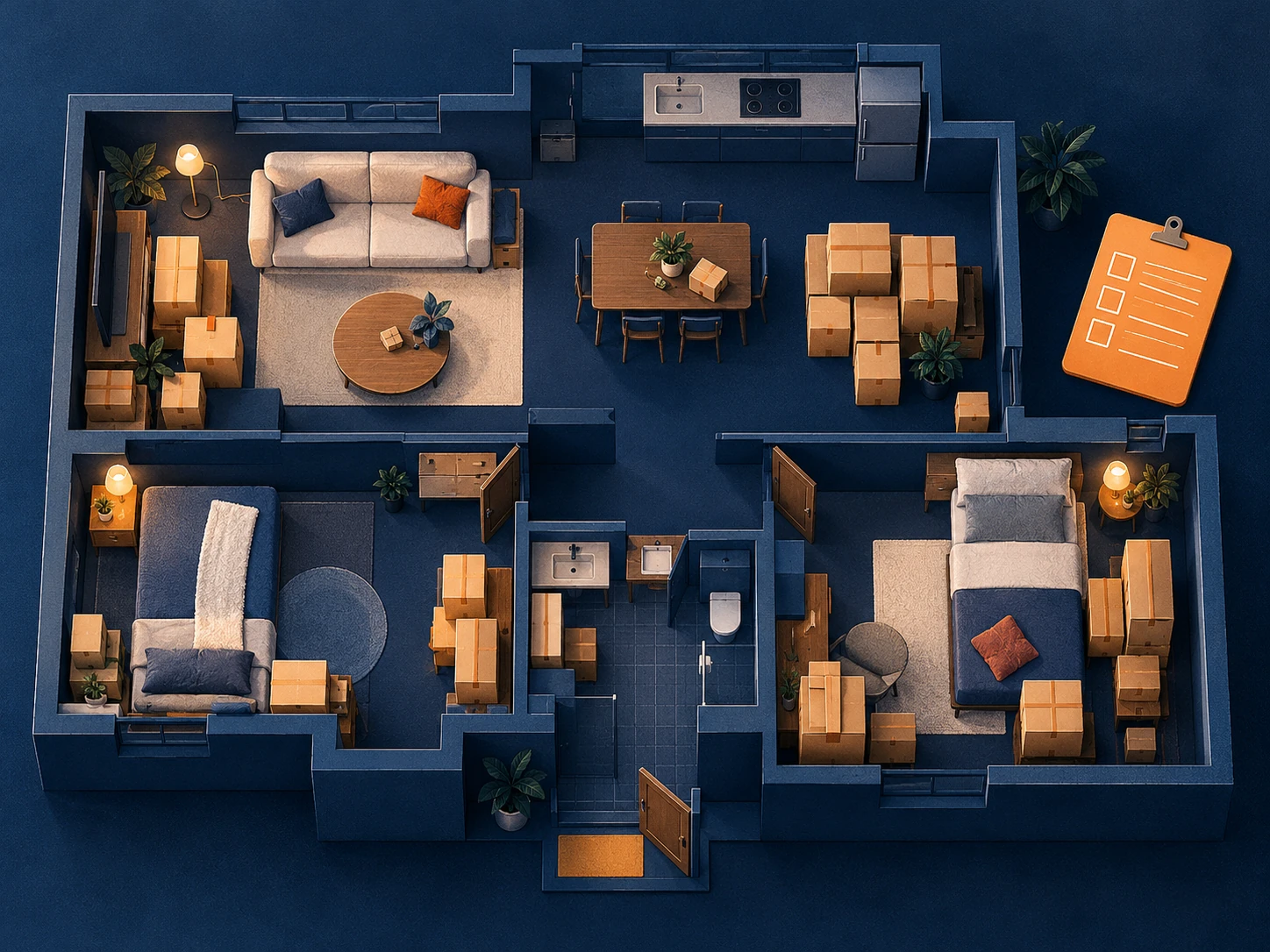
BoxCount's default two-bedroom example estimates 43-61 cartons, including 2-3 wardrobe boxes, large cartons and dish packing boxes. It assumes a 1,200 sq ft house (about 111 sq m), two people, average belongings and wardrobe clothing, a typical kitchen, a same-city move, no added books or fragile items, and no selected TV, artwork, or large furniture. Storage is set to none and the whole household is moving. This is the planner's starting scenario, not a surveyed average for every two-bedroom home.
Use a range for the first shopping trip. The lower end fits a lighter household or a move that includes serious decluttering. The higher end gives more room when storage areas are full, several people share the home, or you are protecting many fragile belongings. Neither end is a guarantee. Recalculate when your first packed room gives you better evidence.
How bedrooms and square footage work together
Bedrooms help describe how many living and storage zones need to be packed. Square footage helps distinguish a compact apartment from a more generously furnished home with the same bedroom count. Home type also matters because a house may include a garage, basement, attic, or larger storage areas that an apartment does not. Use all three details as context rather than treating any one field as a guarantee.
- A studio or one-bedroom home may still need many cartons when it has a full kitchen, home office, storage unit, or large book collection.
- A two-bedroom home is a useful calculator baseline, but the result should be adjusted for how full the rooms are and whether storage spaces are included.
- A three- or four-bedroom home may need fewer boxes than expected after decluttering, or more when every closet and outbuilding is included.
- Square footage that includes unfinished, rarely used, or shared areas may not translate directly into packed belongings.
Before shopping, walk through every space with a note on your phone. Record bedrooms, closets, kitchen cabinets, bookshelves, office areas, garage or storage zones, and any items that need unusual protection. You are looking for categories that change the mix, not an exact item-by-item inventory.
A two-bedroom example using the calculator baseline
With the default inputs above, the mix is 16-22 medium boxes (18 by 18 by 16 inches), 12-17 small boxes (16 by 12 by 12 inches), 6-9 book boxes (12 by 12 by 12 inches), 6-8 large boxes, 2-3 wardrobe boxes and 1-2 dish packing boxes. Together these give 43-61 cartons. Set wardrobe clothing to None if you will use bags or suitcases, and refine books, kitchen and storage before shopping.
Now adjust the example. A household with a large book collection should expect the small-box portion to rise because books are dense. A household with many hanging clothes may need more wardrobe boxes. A kitchen with a large dish collection can increase the need for small or medium cartons and protective paper. If the move is long-distance, the calculator may increase protective supplies because the contents will spend more time in transit.
After the first packing session, compare the result by category. If a bedroom used fewer standard boxes but the office used more small boxes, do not simply buy more of every size. Revise the input that best explains the difference and keep your next purchase focused.
Adjust for the belongings that change the count
- Books: add small cartons and keep each one liftable. A book collection changes box size more than it changes room count.
- Clothing: separate folded clothing from hanging clothing. Wardrobe cartons are useful for the latter, while medium cartons handle the former.
- Fragile items: plan for more paper, bubble wrap, and smaller stable cartons. Protection takes space, so a tightly packed estimate may not be enough.
- Distance: longer moves can justify additional protective material and stronger packing decisions, even when the number of boxes stays similar.
- Belongings level: choose light, average, or high based on what you are actually keeping, including storage areas that are easy to forget.
Revise the plan after your first room
Pack one low-risk room or storage area before placing the largest supply order. Count boxes by type, note whether they were full or partly full, and write down any category that surprised you. A first session reveals your packing style: some people use generous padding, while others fit items tightly. Both choices change the number of cartons and protective supplies.
- If you run out of small boxes first, check books, pantry goods, tools, and dishes before buying more standard cartons.
- If standard boxes remain mostly empty, reserve them for light bulky items and move dense contents into smaller cartons.
- If fragile boxes require much more room, raise the protection estimate rather than squeezing pieces together.
- If you have many unused cartons, keep them unopened when possible so they can be exchanged or used for late discoveries.
This feedback loop is more reliable than a universal rule because it uses your actual belongings. The calculator gives you a sensible first pass; your first packed room supplies the correction.
Buy a modest buffer and keep it useful
A small buffer helps when you have not finished decluttering, are reusing boxes of uncertain strength, or are moving items that need extra padding. Keep the buffer modest. Too many cartons take up space, encourage rushed packing, and leave you with supplies you may not need. Prioritize the sizes and materials your inventory has already shown you need.
- Select bedrooms, home type, and approximate square footage.
- Choose the belongings level that matches what you are keeping.
- Set books, fragile items, and wardrobe clothing separately.
- Include move distance because it changes protective supply needs.
- Pack one room, compare the box mix, and adjust before the next purchase.
- Keep a first-night box outside the main count so it remains easy to find.
What to do when the estimate misses
A first estimate can miss because a storage room was overlooked, decluttering happened after the calculation, or the household packs with more protective material than expected. Treat the difference as information. Count the cartons already used by size and compare them with the rooms that remain. That tells you whether the next purchase needs more small boxes, more light-volume cartons, or more protection.
Avoid correcting a shortage by filling large boxes with dense contents. Split heavy categories first, then use standard boxes for pillows, linens, and other light items. If you have cartons left over, keep them for the final kitchen and bathroom pass rather than opening everything at once. A controlled revision is easier to manage than a last-minute pile of mixed boxes.
Keep the count visible on a simple note: room, box size, full or partial, and handling note. That record helps anyone packing after you make the same decisions. It also gives you a clearer explanation for the next estimate than a memory of how many cartons seemed to be left.
Use the calculator for a personalized starting estimate. Exact needs vary, so adjust it after you take inventory.
Use the moving supplies calculator