Moving Box Sizes: What to Use for Every Room
Choose the right small, medium, standard, or wardrobe box for each room, item, and weight.
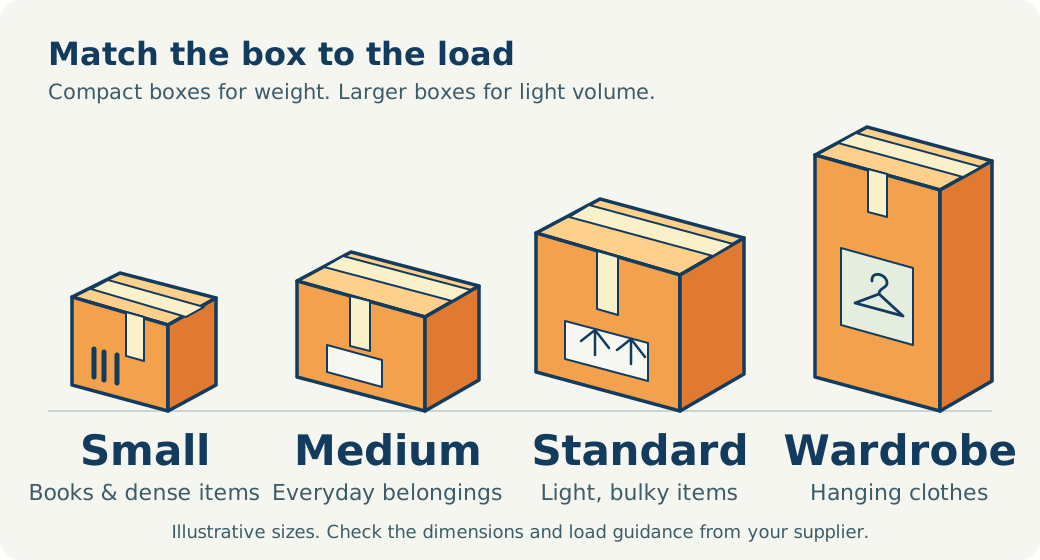
Choose a box by weight before volume
The right moving box is the one that groups similar items without becoming awkward to lift. Start with the weight of the contents, then choose the size that gives those items enough room to sit securely. Small boxes handle dense belongings such as books, canned food, tools, and records. Medium boxes are a flexible choice for everyday household items. Standard boxes are best for bulky belongings that are light enough to carry. Wardrobe boxes keep hanging clothes upright, but they are a convenience rather than a solution for every garment.
Box dimensions vary by supplier, so treat the measurements below as the BoxCount Planner categories rather than a promise about every carton you will find. A box that is a little different can still work when its contents are balanced, cushioned, and easy to lift. The goal is a usable packing system, not identical cartons.
Moving box sizes at a glance
| Box | Common dimensions | Good for | Weight note |
|---|---|---|---|
| Small | 12" x 12" x 12" | Books, canned food, tools, shoes, records, and dense kitchen items | Keep the contents dense but liftable; use another box before it becomes a strain |
| Medium | 16" x 12" x 12" | Dishes with padding, cookware, toys, folded clothes, office supplies, and small appliances | The everyday size; combine light and medium-weight contents carefully |
| Standard | 18" x 18" x 16" | Linens, pillows, lampshades, towels, cushions, and other bulky light items | Fill the space without turning a light-volume box into a heavy one |
| Wardrobe | Varies by supplier | Shirts, jackets, dresses, suits, and other clothes that stay on hangers | Use the bar for hanging clothes only and avoid overloading it |
Match box size to each room
Room labels are useful, but rooms do not all contain the same mix of weight and volume. A kitchen may need several small boxes for pantry goods and dishes, medium boxes for cookware, and a standard box for towels. A bedroom usually needs medium boxes for folded clothing and nightstand contents, standard boxes for bedding, and wardrobe boxes for hanging items. The living room often breaks into small boxes for books, medium boxes for décor and electronics accessories, and standard boxes for cushions.
- Kitchen: use small cartons for canned goods, spices, and dishes; medium cartons for cookware and appliances; standard cartons for towels and light containers.
- Bedroom: use medium cartons for folded clothes and shoes, standard cartons for bedding and pillows, and wardrobe cartons for hanging pieces.
- Living room: use small cartons for books and media, medium cartons for décor and cables, and standard cartons for cushions, throws, and lampshades.
- Home office: use small cartons for books and paper, medium cartons for supplies, and separate protection for computers and valuable documents.
- Garage or storage: use small cartons for hardware and tools, but keep sharp or oily items contained and clearly identified.
Pack one destination room at a time when possible. If a carton contains items from two rooms, write both destinations on the label and explain which contents belong where. That extra sentence is faster than sorting anonymous boxes after a long moving day.
Books, fragile items, and wardrobe clothing
Books are compact and heavy, so they belong in small boxes. Pack them upright with their spines supported, flat in short stacks, or in a combination that keeps covers from bending over empty space. Leave a little room at the top for a cushion and test the weight before sealing. A large box that is only half full may still be too heavy when the half that is full contains hardback books.
Fragile belongings need a box with room for layers, not a carton packed tightly just to save space. Cushion the bottom, wrap pieces individually, separate hard surfaces, and fill movement gaps. Plates are usually more stable on edge than in a tall flat stack. Glasses need protection around bowls, rims, and stems. Labeling helps movers notice the box, but it cannot compensate for loose contents.
Wardrobe boxes are useful when you want to move hanging clothes without folding them. Leave enough space for the bar and do not fill the lower area with dense items. Folded clothing, shoes, and accessories are usually easier to manage in medium boxes. Keep one week of clothing out until the last packing session.
A packing sequence that keeps sizes useful
- Start with storage areas, guest rooms, and seasonal items. Use labels such as 'Guest room — linens' so the first cartons have clear destinations.
- Pack books, records, tools, and pantry goods into small boxes while you can still lift and stack them safely.
- Move through bedrooms and offices with medium boxes for everyday belongings and standard boxes for light, bulky pieces.
- Pack fragile kitchen and décor items with enough padding, then mark those cartons on two sides and the top.
- Leave daily toiletries, chargers, medication, basic dishes, towels, and a change of clothes for a clearly marked first-night box.
Label two sides of each carton with the destination room, a short contents note, and a simple weight or handling note such as HEAVY or FRAGILE. Labels on two sides remain visible when boxes are stacked. Keep a small count by room if you want to compare your real inventory with the calculator estimate.
Common box-size mistakes
- Using standard cartons for books, dishes, or tools because the larger carton looks more efficient.
- Filling a box by volume without checking whether the sealed weight is manageable.
- Leaving empty space around fragile pieces and expecting a FRAGILE label to prevent movement.
- Buying only one size and forcing light pillows and dense cookware into the same carton.
- Mixing rooms without recording the new destination, which creates work during unloading.
- Treating the calculator range as an inventory count instead of revising it as packing reveals what you own.
Use your estimate as a shopping starting point
BoxCount Planner uses home details, belongings, books, fragile items, wardrobe clothing, and move distance to produce a practical supply range. Use that range to begin shopping, then make room for what your first packed room teaches you. If the first session produces more small boxes than expected, update the books or belongings inputs instead of compensating with oversized cartons.
- Is the item dense or heavy? Start with a small box.
- Is it a typical household item? Try a medium box.
- Is it bulky but light? Use a standard box.
- Does it need to stay on a hanger? Use a wardrobe box.
- Can you lift the sealed carton comfortably from the bottom?
- Have you reserved supplies for fragile items and a first-night box?
Plan for the boxes you will handle twice
A carton is carried from the room to the loading area, then from the vehicle to its destination. Choose a size that remains stable through both trips, including stairs, doorways, and the time it may sit in a stack. A box that barely fits an item at home can be the wrong choice if it cannot be gripped comfortably or if its contents shift when tilted.
Keep a few medium cartons available for late discoveries and awkward combinations. Use them for items that do not belong in a dense small box or a loose standard box. Before shopping, measure any unusually large item and check the new home's doorways if the carton will be assembled around it. The most useful box-size plan leaves room for real handling, not just the dimensions on a shelf.
Use the calculator for a personalized starting estimate. Exact needs vary, so adjust it after you take inventory.
Use the moving supplies calculator