Moving Supplies Checklist
A practical list of boxes, protection, labeling tools, and first-night essentials for a smoother move.
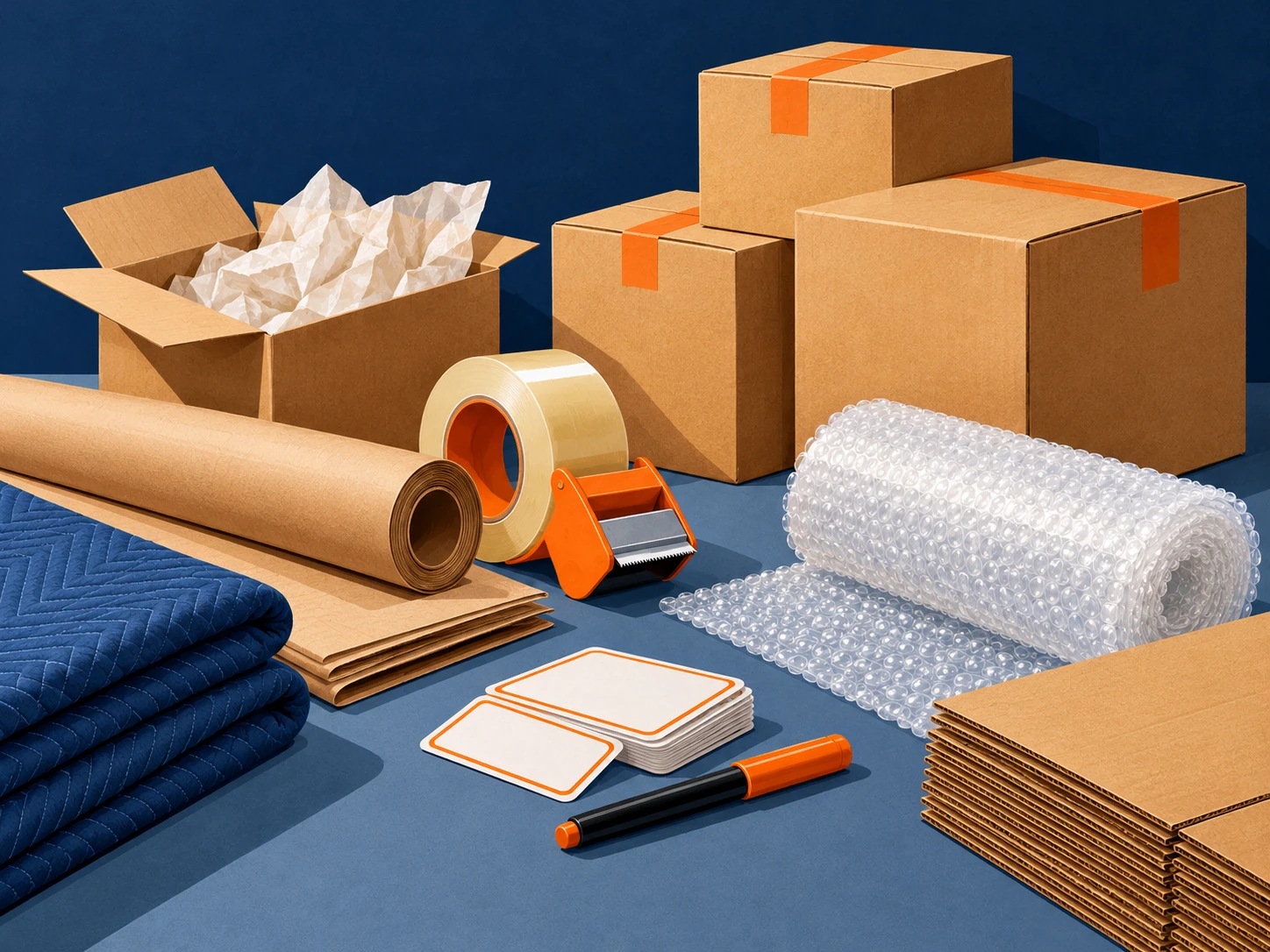
Start with the supplies that keep packing moving
A useful moving supplies checklist is organized around the work you will do, not a long shopping list of items that may never leave the package. Boxes hold the inventory, protective materials prevent movement and surface damage, tape and labels close the loop, and a first-night kit keeps essentials separate. Gather the basics before packing day so you do not stop midway through a room to search for a marker or a safe place to put loose screws.
Use the calculator for quantities, then use this checklist to decide what each item is for. The right amount depends on your belongings, packing style, distance, and the help available. Keep a small amount of general-purpose material in reserve for the last room and the items you discover after you thought you were finished.
Boxes: buy a useful mix
- Small boxes for books, records, tools, pantry goods, and other dense items
- Medium boxes for dishes with padding, cookware, folded clothes, toys, and office supplies
- Standard boxes for linens, towels, pillows, lampshades, and other bulky light items
- Wardrobe boxes when hanging clothes should move without being folded
- A few sturdy cartons for irregular items that need a stable base
- Paper or reusable labels that can be read from two sides of the carton
Do not choose one large box size just because it appears to offer more volume. Large cartons become difficult when filled with books, dishes, tools, or pantry items. A mixed supply lets you keep dense belongings manageable and reserve standard cartons for the light items that actually benefit from their space.
Check the condition of reused boxes before trusting them. Reject cartons with damp spots, crushed corners, weak bottoms, or a smell that could transfer to clothing or paper. Use a fresh box for fragile or valuable items when the strength of a reused carton is uncertain.
Protection: match the material to the object
Packing paper is versatile for wrapping dishes, glasses, décor, and surfaces that could scratch. Bubble wrap adds a thicker cushion around especially delicate pieces, corners, and electronics. Furniture blankets or pads protect large surfaces during carrying and loading. Towels and soft clothing can fill some gaps, but they should be clean and should not be the only protection around breakable objects.
- Use crumpled paper or a folded pad at the bottom of fragile cartons before adding the first layer.
- Wrap each breakable item separately; do not let glass, ceramic, or metal surfaces touch.
- Put extra protection around rims, stems, corners, screens, and thin edges.
- Fill empty spaces so contents cannot rattle, slide, or settle into a hard impact point.
- Keep furniture blankets available near the loading area rather than buried inside a carton.
Sealing, labeling, and the small tools that matter
Packing tape is the basic closing tool. Apply a continuous strip across the center seam and reinforce a weak bottom before loading. A tape dispenser speeds up repeated sealing, but sturdy scissors can work when that is what you have. Permanent markers should remain legible on cardboard; use labels when a surface is dark, glossy, or likely to be reused.
- Write the destination room on two sides and the top when the carton may be stacked.
- Add a short contents note so you can find one item without opening every box.
- Mark HEAVY, FRAGILE, or THIS SIDE UP only when the label describes a real handling need.
- Keep a box cutter, measuring tape, markers, scissors, and spare tape in a small tool pouch.
- Use resealable bags for screws, remote controls, cords, and hardware; label the bag and attach it to the related item.
A clear label is for the person unloading as much as it is for the person packing. Put the destination where it can be seen from the hallway, and avoid relying on a color code that only one helper understands.
Furniture and appliances need a separate plan
Cartons do not solve every moving problem. Furniture may need blankets, stretch wrap, corner protection, sliders, or a way to keep doors and drawers closed during carrying. Appliances need to be emptied, cleaned, and secured according to their design and any instructions you already have. Photograph connections before disconnecting electronics or appliances, and place small hardware in labeled bags.
- Furniture blankets or pads for finished surfaces and corners
- Stretch wrap for keeping drawers, doors, and protective blankets in place without taping directly to finished surfaces
- A dolly or moving straps when the route and available help make them appropriate
- Zip bags, labels, and tape for hardware, cords, shelves, and remote controls
- Basic cleaning cloths and bags for wiping items before they enter the new space
- A measuring tape for checking tight doorways, elevators, and furniture clearances
Protect the route as well as the item. A blanket over a banister or a clear path through a hallway can prevent damage that no amount of box labeling will fix. If an item is unusually large or heavy, plan the carry before packing the smaller boxes around it.
Pack a first-night kit
The first-night kit is the supply category people often remember too late. Pack it in a clearly marked tote or carton and load it last so it comes off first. Include chargers, medication, toiletries, toilet paper, paper towels, a change of clothes, basic dishes or cups, snacks, water, a flashlight, and the tools needed to open boxes. Add documents, pet supplies, or child essentials that your household needs immediately.
- Chargers, medication, toiletries, and a change of clothes
- Toilet paper, paper towels, trash bags, and basic cleaning supplies
- Snacks, water, coffee or tea supplies, and simple dishes
- Flashlight, scissors or box cutter, tape, markers, and a small tool set
- Sheets, towels, and any pet, child, or accessibility essentials
- A printed or saved copy of important move details and contact information
Turn the list into a shopping plan
Run your home details through the BoxCount Planner calculator before buying quantities. Its categories include standard, medium, small, and wardrobe boxes, plus tape, bubble wrap, paper, markers, furniture blankets, stretch wrap, and scissors or a box cutter. The result is a starting range. Compare it with your inventory and make sure the box sizes match the weight of your belongings.
For a printable checklist, calculate your supplies and use Print Checklist. Keep the printed list with the packing tools, not in a drawer that gets sealed into a carton. Recheck the list after the first room and update the estimate when the real mix differs from the starting range.
Set up a packing station
Keep tape, markers, labels, paper, scissors, and a trash bag together in a small moving station. Bring that station to the room you are packing instead of walking back and forth for each carton. Place a few open boxes nearby, but do not open more cartons than you can finish and label in one session.
Use a clean surface for wrapping fragile pieces and a separate spot for items that need decisions. That separation keeps donations, recycling, hardware, and packed belongings from being sealed together by accident. At the end of a session, close every finished box, record its room, and return the tools to the station.
Use the calculator for a personalized starting estimate. Exact needs vary, so adjust it after you take inventory.
Use the moving supplies calculator