How to Pack Fragile Items for Moving
Protect dishes, glassware, and delicate objects with simple layers, stable boxes, and less empty space.
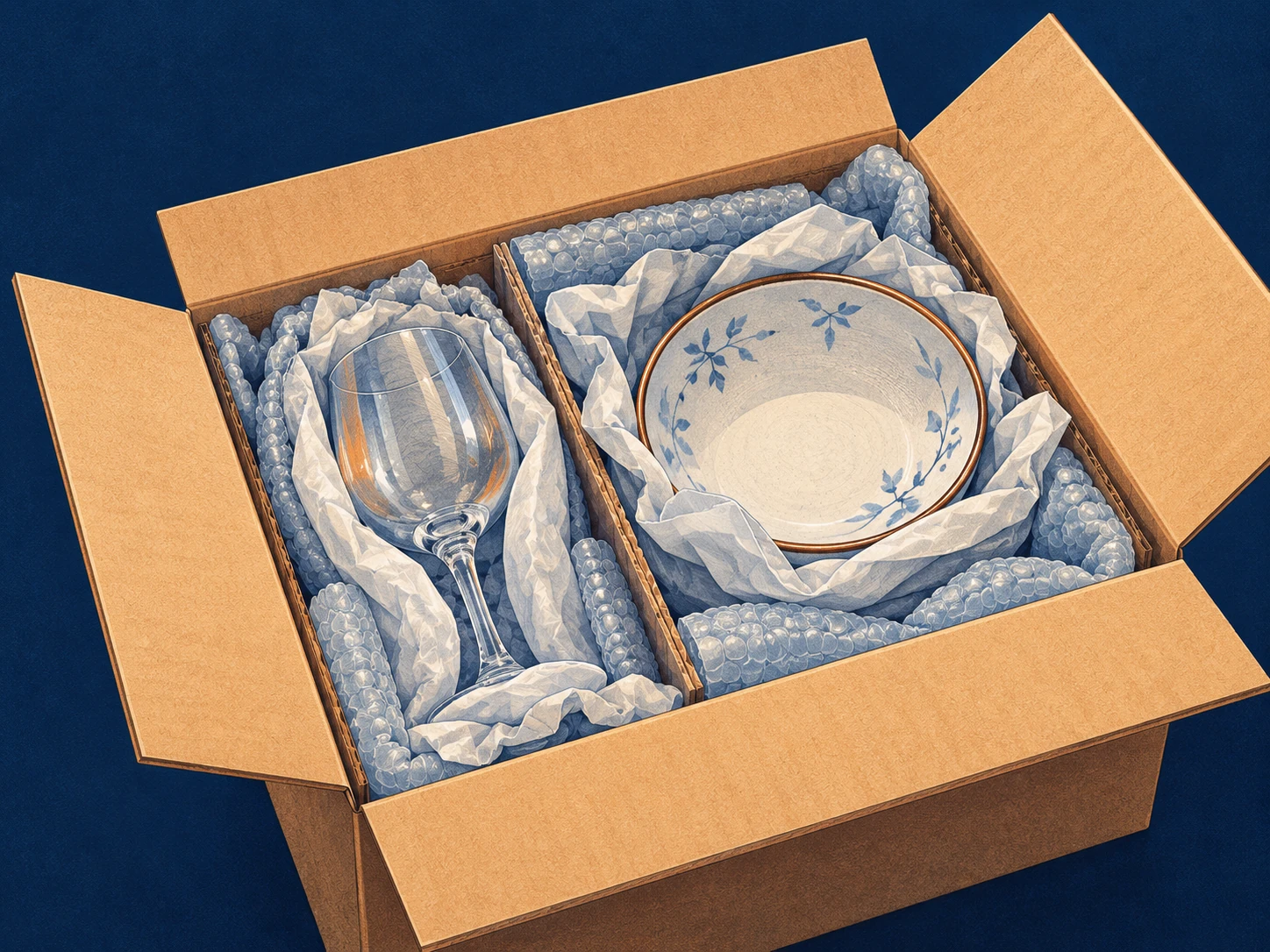
Sort fragile items before you wrap
Fragile packing starts with sorting, not paper. Gather dishes, glassware, ceramics, framed art, electronics, mirrors, and delicate décor in one place. Separate pieces that need different treatment: a stemmed glass should not share a loose box with a cast-iron pan, and a framed print needs edge and surface protection rather than a pile of crumpled paper on top.
- Group objects by material, shape, and vulnerability.
- Remove batteries, loose parts, removable shelves, and accessories when they can shift or cause damage.
- Photograph electronics and cable connections before disconnecting them.
- Set aside items that need a custom crate, original packaging, or special handling rather than forcing them into a regular carton.
- Keep valuables and irreplaceable documents with you when possible instead of placing them in the moving load.
The goal is to make each box predictable. A predictable box is easier to cushion, label, lift, and inspect than one that combines every object you have not decided how to pack.
Choose a stable box and build the bottom layer
Choose a clean, sturdy small or medium box with enough room for padding around the contents. A carton that is too large invites gaps and becomes harder to control. A carton that is too small forces pieces against the walls. Inspect the seams and corners, then reinforce the bottom with packing tape before adding a cushion of crumpled paper, a folded towel, or another suitable pad.
The bottom layer should absorb movement before the first object reaches the cardboard. Add enough material to create a soft base without using so much that the box becomes unstable. Keep heavy pieces low and lighter pieces above them, while maintaining space for protection between every hard surface.
Wrap dishes, glasses, and ceramics
Wrap dishes individually and add extra material around rims and edges. Place plates on their edges in a short, supported row rather than building a tall flat stack that can transfer impact through the whole pile. Separate bowls and nesting pieces with paper so they do not lock together under pressure. Finish with a top cushion before closing the flaps.
For glasses, protect the bowl, rim, and stem separately when the shape calls for it. Wrap each piece so it cannot knock against the next one, then place it in a stable arrangement with cushioning between rows. Do not let a stem rest against a hard edge. Fill gaps with paper until a gentle movement test produces no rattle.
- Use paper for clean separation and surface protection around dishes and glassware.
- Add bubble wrap around especially delicate pieces, thin handles, or vulnerable corners.
- Keep metal, ceramic, and glass from touching even when each piece appears sturdy.
- Use a smaller carton when the packed box becomes difficult to lift.
- Mark the destination room and FRAGILE on two visible sides after the contents pass the movement test.
Protect electronics, artwork, and décor
Electronics need protection from impact, scratching, and loose accessories. Use original packaging when it is available and still fits. Otherwise wrap the device in a soft layer, add bubble wrap around corners and screens, and keep cables in a labeled bag. Do not put heavy objects on top of a screen or assume a blanket alone prevents pressure damage.
For framed artwork and mirrors, protect the face, corners, and edges. Place pieces upright when the shape and container allow it, separate them with padding, and avoid stacking heavy cartons against the frame. Small décor items can share a box when each piece is wrapped and the gaps are filled, but large or unusually shaped objects may need their own carton.
- Wrap screens and glossy surfaces in a non-abrasive layer before adding cushioning.
- Use corner protection for frames, table edges, and objects with thin projections.
- Label accessory bags with the item they belong to and keep them in the same destination box.
- Keep fragile cartons away from heavy furniture during loading and unloading.
Paper, bubble wrap, and void fill
Packing paper is useful for wrapping, separating, and filling. It conforms to many shapes and is easy to remove when unpacking. Bubble wrap adds more cushioning but can take more room and may not protect an object if it is used as the only layer around a sharp corner. Use the material that answers the actual risk: surface contact, impact, movement, or a vulnerable edge.
Void fill should stop objects from shifting in every direction. Crumple paper rather than laying flat sheets across a large gap. Add fill along the sides, between pieces, and across the top. Close the flaps without forcing them. If they bow upward, the carton is too full or needs a different arrangement.
Seal, label, and inspect
Seal the center seam and reinforce the bottom when the carton is dense. Write the destination room, a short contents note, and FRAGILE on two sides and the top. Add THIS SIDE UP only when the contents genuinely have a preferred orientation. Labels help people make good decisions at the truck, but they are not a substitute for a stable box.
- Check that no item touches the cardboard directly at a vulnerable point.
- Confirm that the carton can be lifted from the bottom without flexing or splitting.
- Keep fragile boxes where they will not be crushed by furniture or dense cartons.
- Tell helpers which boxes need careful handling or two-person lifting.
- Inspect the outside of each carton after loading and again when it reaches the new room.
If a box is dropped, crushed, wet, or opened during the move, inspect the contents before carrying it farther. Repack damaged cartons rather than assuming the inner layers are still in place.
Mistakes that cause breakage
- Wrapping several fragile pieces together so hard surfaces can still touch.
- Using a large box to save cartons and then filling it with dense or delicate items.
- Leaving side and top gaps because the bottom was padded.
- Relying on bubble wrap without protecting corners, rims, or stems.
- Putting a fragile carton under a heavy one because the label was visible only on top.
- Sealing the box without a lift or movement test.
Estimate the fragile supplies before shopping
In BoxCount Planner, choose the fragile-items level that best matches what you are keeping. The calculator uses that input alongside home size, belongings, books, wardrobe clothing, and distance to estimate protective supplies. Treat the result as a starting range, then add or remove material after sorting your actual fragile inventory. A large collection of glassware needs a different plan from a few framed photos.
- Sort fragile pieces by material and shape.
- Choose stable small or medium cartons.
- Pad the bottom, wrap individually, and fill all movement gaps.
- Use the movement and lift tests before sealing.
- Label two sides and the top with the destination and handling note.
- Keep fragile boxes above dense cartons during loading.
Know when a regular carton is not enough
Some pieces deserve a different plan. Oversized mirrors, unusually valuable artwork, delicate antiques, and objects with loose moving parts may need original packaging, a custom container, or a professional packing decision. Do not force an irreplaceable item into a box just because the carton is available. Measure it, protect the vulnerable surfaces, and decide how it will be carried before the rest of the load is arranged.
For electronics, keep the device, power cable, remote, and labeled accessories together. For framed artwork, protect the face and corners first, then choose a position that avoids pressure from other cartons. The safest fragile workflow is the one that makes the risk visible before loading begins.
Use the calculator for a personalized starting estimate. Exact needs vary, so adjust it after you take inventory.
Use the moving supplies calculator