How to Label Moving Boxes So Unpacking Is Easier
Use room names, numbers, contents, priorities, and handling notes to make every box easier to load, find, and unpack.
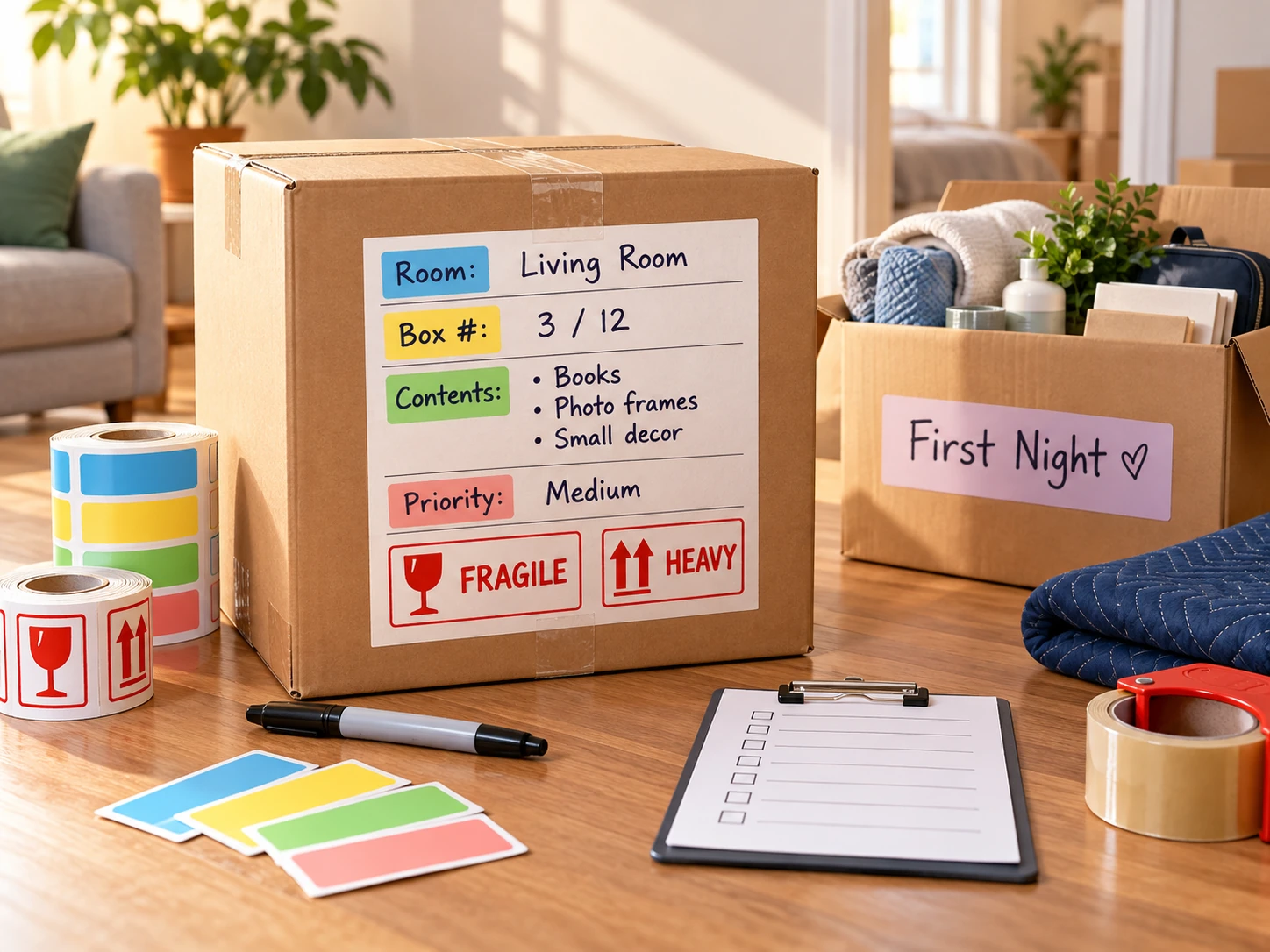
Use one label format for every box
The easiest way to label moving boxes is to give every carton the same small set of facts. Put the destination room first, then a box number, a short contents note, a priority, and any handling warning. For example: "KITCHEN — 07 — pans and utensils — OPEN FIRST — HEAVY." A helper can understand that label without asking who packed it or opening the carton.
Choose a numbering system before the first box is sealed. You can number boxes by room, such as Kitchen 01 and Bedroom 01, or use one sequence for the whole move. Room-based numbers are quick to scan during unloading; one global sequence makes an inventory simpler. Either works if the same format appears on the label and in your list.
The five fields worth writing
| Box | Common dimensions | Good for | Weight note |
|---|---|---|---|
| Room | Large and first | Kitchen, bedroom, office, storage, or the exact destination | Use the room name used at the new home |
| Box number | Room 01 or 001 | A unique number that matches your inventory | Do not reuse numbers after a box is donated or repacked |
| Contents | Short phrase | Pans and utensils, books A–L, towels, or TV cables | Name the category, not every individual object |
| Priority | Open first / later | First-night, first day, soon, or storage | Use one shared vocabulary |
| Handling | FRAGILE / HEAVY | A real lifting or protection warning | A label supports packing; it does not replace padding |
Add color without making it the only system
Color coding can make a stack readable from the hallway. Assign one color to each destination room and use colored tape, large stickers, or a marker stripe. Put the room name on the label anyway. A color may look different in dim light, a helper may be color-blind, or a label may be partly covered after stacking. Text is the reliable system; color is a fast visual cue.
- Pick colors that are easy to distinguish and record them on the inventory sheet.
- Use the same color on the room sign at the new home so boxes have a visible destination.
- Mark shared or mixed boxes with both room names instead of forcing them into one color.
- Reserve a high-contrast mark for first-night and open-first boxes so they stand apart from ordinary cartons.
Label two sides, the top, and the useful end
Write the main label on at least two adjacent sides and on the top. Two sides stay visible when boxes are stacked; the top helps when a box is still on the floor. If the carton has a narrow end that faces the hallway or vehicle, repeat the room and number there too. Large block lettering is easier to read than a small complete sentence.
Label after the contents are packed but before the carton joins the loading area. Use a waterproof marker on cardboard, or attach a label that will not curl when the box is handled. If rain is possible, cover paper labels with clear tape or use a weather-resistant label while keeping the writing legible.
Keep an inventory that answers the next question
A label tells you what a box is; an inventory tells you where the whole move stands. Keep one line per box with its number, room, short contents, priority, handling note, and status. Add an approximate value or a more detailed note only when it helps your household or moving paperwork. The goal is a usable list, not a second packing project.
- K07 — Kitchen — pans and utensils — open soon — heavy — loaded
- B03 — Bedroom — winter clothes — later — standard — not loaded
- L02 — Living room — lamp and shades — first day — fragile — loaded
An optional QR code or digital inventory can make searching faster when the list is large. Use it as a convenience, not as the only record: a phone may be out of battery, offline, wet, or packed inside the box you need. Keep a printed copy or a simple handwritten backup with the moving tools.
Use different notes for books, kitchen, and furniture
The contents field should be specific enough to guide unpacking. For books, add the shelf or a broad range such as "office — history A–L". For kitchen boxes, name the group: "baking pans", "daily dishes", or "coffee supplies". A box marked only KITCHEN still leaves you searching through every carton when you need one pan.
Furniture and large pieces may not fit in a carton, but they still need destination and handling notes. Mark a wrapped dresser with the room, piece name, and any TWO-PERSON LIFT or KEEP UPRIGHT instruction. For a TV, label the screen package with its destination and keep the stand, remote, cables, and mounting hardware in a matching accessory bag.
Make the first-night box impossible to miss
Use a tote or sturdy carton for the first-night box and write FIRST NIGHT on every visible side. Include medication, chargers, toiletries, toilet paper, paper towels, a change of clothes, snacks, water, basic dishes, a flashlight, and the tools needed to open cartons. Add pet, child, accessibility, or document essentials that your household needs immediately.
- FIRST NIGHT is written in large letters on two sides and the top.
- The box has a room destination or a clear instruction such as KEEP WITH US.
- Chargers, medication, toiletries, clothes, towels, and basic food are packed.
- A box cutter, scissors, tape, marker, and small tool set are outside the load or in the same accessible kit.
- The box is loaded last so it can be unloaded first.
Write what helps, not what creates risk
Avoid putting sensitive details on an exterior label that strangers, neighbors, or passersby can read. Do not write cash, jewelry, passports, medication names, expensive electronics, or a full address on a box. Use a neutral description such as "personal items" and keep a private inventory for anything that needs closer tracking. Marking a box VALUABLE can also attract attention without improving its protection.
Avoid absolute handling claims that the package cannot support. FRAGILE is useful when the contents are padded and the box is stable; it is not a guarantee that the carton will never be dropped. Use HEAVY when the box needs a different lifting decision, and use THIS SIDE UP only when orientation genuinely matters.
Coordinate loading and unpacking with the labels
Before moving day, show helpers the label format and place a sign for each destination room. During loading, keep first-night and open-first boxes accessible, place dense boxes low, and keep fragile cartons away from crushing pressure. Check the number against the inventory as each carton leaves the room. If a box is repacked, update the label and the list together.
At the new home, direct boxes by room instead of creating one large drop zone. Ask helpers to place the carton near its destination wall, not in a doorway or in front of furniture that needs to be assembled. The inventory can tell you what to open next, while the priority note keeps the first useful items within reach.
Common labeling mistakes
- Writing only the room and forgetting a contents note, so every search requires opening boxes.
- Using tiny labels or writing on only the top of a carton that will be stacked.
- Numbering boxes without keeping the matching inventory line.
- Relying on color alone or changing the color meaning halfway through packing.
- Marking every box FRAGILE, which makes the warning less useful and does not improve weak packing.
- Putting a first-night box in the truck before ordinary cartons, then burying it under the load.
- Leaving paper labels exposed to rain or writing on damp cardboard.
- Packing a remote, cable, screw bag, or hardware set separately without naming the item it belongs to.
Final labeling checklist
- Every box has a destination room and unique number.
- The contents note is short but specific enough to find an item later.
- Priority is marked consistently, including the first-night box.
- HEAVY and FRAGILE warnings describe real handling needs.
- The main label appears on two sides and the top.
- Colors match the room key but text still identifies the destination.
- The inventory includes every number, status, and important accessory bag.
- Weather-resistant labels or covered paper are ready for a wet move.
- Boxes are loaded by destination and priority, with dense and fragile items placed thoughtfully.
Use BoxCount Planner before shopping, then print the checklist and keep it with your marker, tape, and inventory. The printable list helps you track boxes and packing supplies while you work, but exact needs vary with your rooms, belongings, box sizes, weather, and available help. Update the plan after the first room instead of treating an estimate as a final inventory.
Use the calculator for a personalized starting estimate. Exact needs vary, so adjust it after you take inventory.
Use the moving supplies calculator