How to Choose the Right Box Size
Check an item's packed dimensions, cushioning space, and carrying weight before choosing between similar-looking cartons.
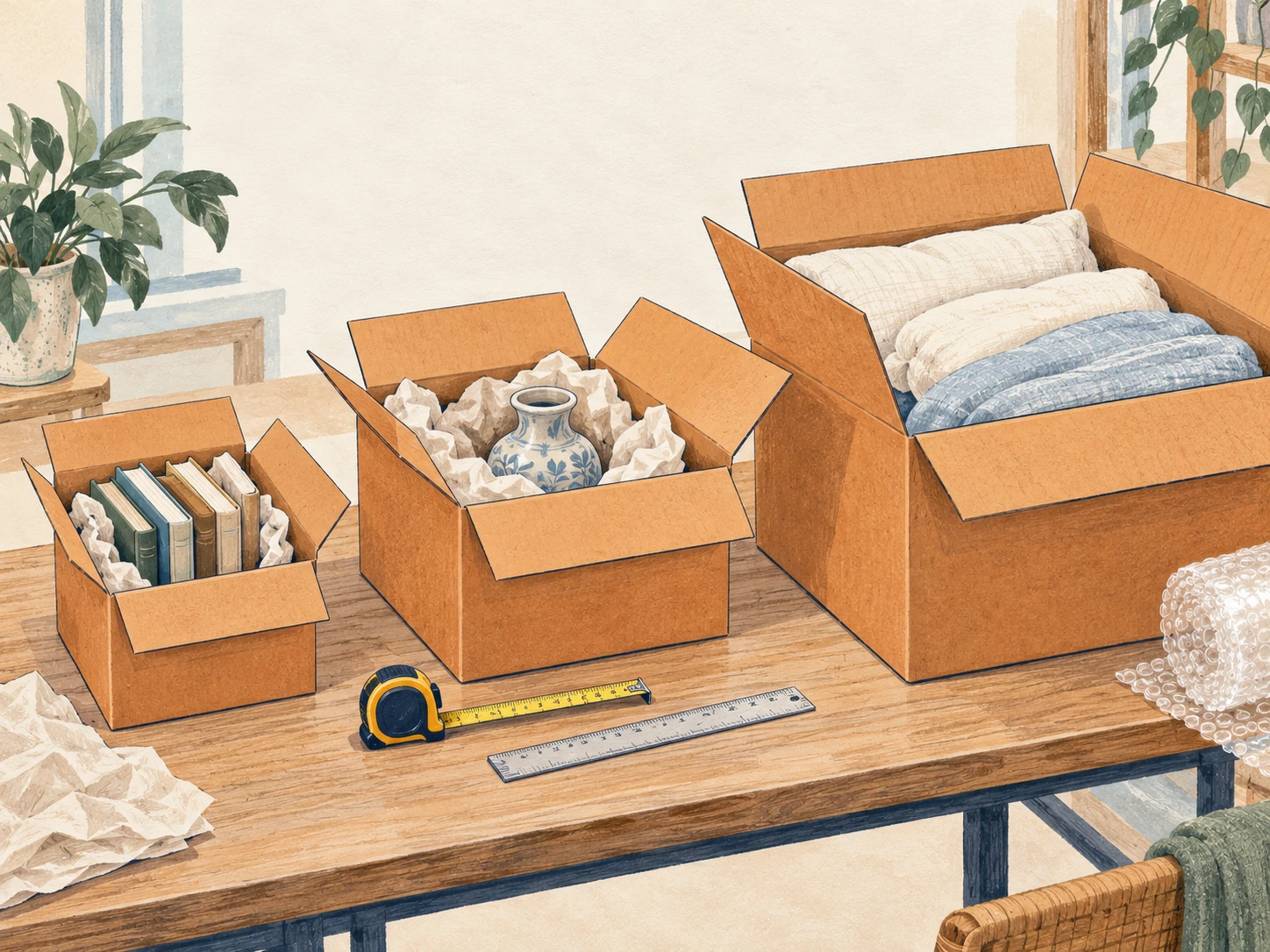
Choose the carton after checking the contents
To choose the right box size for moving, check three things: whether the protected contents fit, whether the carton supports them, and whether the packed box is manageable for the people carrying it. Dense items usually need compact cartons. Bulky, light belongings can use larger ones. Fragile pieces need space for their protection as well as the object itself.
BoxCount's size guide compares categories across the home. This guide helps when you have an object on the table and two possible cartons beside it. Work through the fit and weight checks before assembling the rest of your supply order.
Read dimensions instead of trusting small or medium
A supplier's medium box may be close to another seller's large box. BoxCount uses 12 x 12 x 12 inches for small, 16 x 12 x 12 inches for medium, and 18 x 18 x 16 inches for standard. These are planning categories, not universal retail sizes. U-Haul, for example, calls a 12-inch cube an extra-small book box.
The same BoxCount measurements are approximately 30.5 x 30.5 x 30.5 cm, 40.6 x 30.5 x 30.5 cm, and 45.7 x 45.7 x 40.6 cm. Readers buying in the UK, Canada, or Australia should compare the actual dimensions and units on the listing. A name alone cannot tell you whether your belongings will fit.
Measure the item in its packed position
Place the object in the orientation it will travel in and measure its longest points. Include handles, feet, protruding corners, and any parts that must remain attached. Remove a detachable part only when the item's instructions allow it, and keep the part identified. A vase measured at its opening may be wider at its handles.
Wrap the object with the protection you intend to use, then measure again. The packed footprint is the useful starting point. Leave room for cushioning beneath and above it, and make sure the top flaps can meet without pushing against the object. A carton whose walls bulge is already telling you that the fit needs changing.
Add cushioning space on both sides of each dimension
Use the allowance required by the item's packaging instructions or the chosen packing system. As a sizing example, if an object measures 10 x 8 x 6 inches and its instructions specify 2 inches of protection on every side, the minimum internal space becomes 14 x 12 x 10 inches. Each dimension gains two allowances, one at either end.
That example explains the arithmetic; it does not prescribe 2 inches for every fragile object. Parcel carriers may require a different packing method or a second outer box. Follow their instructions for anything you ship separately, and use fitted packaging or a professional packing service for unusually delicate pieces.
Check strength separately from comfortable carrying weight
A printed carton rating describes a packaging limit or test specification. It does not establish what a person can comfortably carry through your particular home. Check the supplier's instructions, the condition of the box, and the route it will travel. Stairs, narrow landings, and a long carry can make the same load more difficult.
Add dense contents gradually and check the weight before the box is full. If it becomes awkward to control, split the contents between smaller cartons or arrange suitable assistance. Do not fill the remaining space with more books simply because the carton still looks half empty. Use light protective material to stabilize a manageable load.
Use a different solution for awkward shapes
- Books and paper: choose a compact footprint and keep the load manageable before sealing.
- Pillows and dry bedding: use a larger carton that holds the volume without compressing the flaps.
- Hanging clothes: check the wardrobe box's bar instructions and dimensions, including the full length of garments.
- Lampshades: protect the shape in a separate carton and keep other objects from pressing against it.
- Screens, mirrors, and framed artwork: look for a fitted carton or packing kit designed for their shape.
A regular box is a poor bargain when you have to force an item inside it or fill a huge gap around one delicate object. Check whether the original packaging is intact and still has its fitted inserts. For an unusual piece, measure first and choose the packing method before buying a stack of general-purpose cartons.
Trial-pack one box before ordering a bundle
Test one representative carton from the category you use most. For a large library, start with a book box. For a kitchen full of fragile dishes, test the box with its padding and dividers in place. Count how much it holds while staying stable and manageable, then compare that result with your initial estimate.
Reused cartons also need inspection. Set aside boxes with crushed corners, damp areas, split seams, or weakened bottoms. Extra tape cannot restore damaged cardboard. Keep your strongest suitable cartons for belongings that need reliable support, and avoid buying more of a size that failed the trial.
Run the fit check before sealing
- Confirm the actual dimensions and whether they are internal or external.
- Allow for the protected object, including protruding parts and cushioning.
- Check carton condition and the supplier's packing instructions.
- Fill movement gaps without forcing the contents against the walls.
- Close the flaps flat and check that nothing shifts during gentle handling.
- Confirm that the packed weight and carrying route are manageable.
Use the BoxCount calculator to estimate the starting mix of carton sizes. Adjust that mix after the trial pack: a heavy collection may need more compact cartons, while linens need volume. Record actual dimensions on your shopping list so a supplier's different size names do not change the plan.
Use the calculator for a personalized starting estimate. Exact needs vary, so adjust it after you take inventory.
Use the moving supplies calculator